Dr. Micaela Gobeille received a research subaward for a multi-site study evaluating an educational intervention for vision loss adjustment. The study, conducted with Dr. Ali Raza and MGH’s Ophthalmic Psychiatry program, and funded by the Hadley Institute, addresses a critical gap people with low vision experience high rates of depression and anxiety with limited access to mental health resources. By testing a scalable intervention suitable for low vision clinics, the research aims to expand access to psychosocial support and enhance quality of life for individuals with visual impairment.
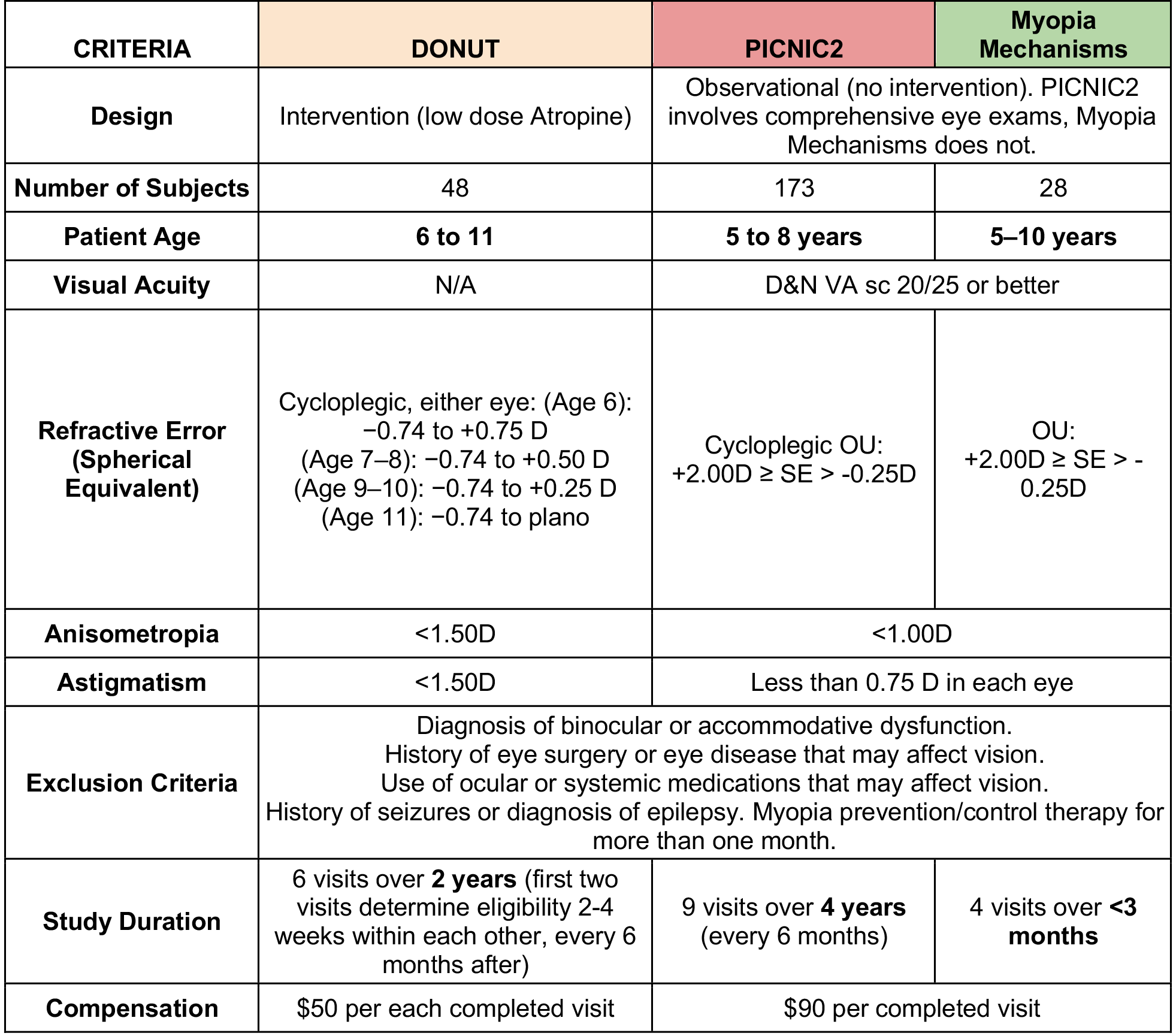
Dr. Kristen Kerber received a subaward for the Delaying the Onset of Nearsightedness Until Treatment (DONUT) Study, awarded $25 million in NIH funding through the National Eye Institute. Myopia remains one of the biggest eye threats of the century, yet preventive interventions remain limited. This multi-site clinical trial will evaluate whether nightly low-dose atropine eye drops can delay the onset or slow the progression of myopia in children. By testing this scalable, accessible intervention across diverse populations, the study aims to provide evidence-based strategies for myopia prevention and reduce the lifelong burden of refractive error in pediatric populations.
Dr. Nicole Ross has been awarded multiple collaborative subawards supporting innovative research partnerships across leading institutions. These include a Harvard Catalyst award with Dr. Corinna Bauer to identify and address critical gaps in care for individuals with Cerebral/Cortical Visual Impairment (CVI), a collaborative research award with Dr. Aaron Seitz at Northeastern University focused on advancing vision science research, and a Lahey Internal Research Grant in collaboration with Dr. David Ramsey (adjunct faculty at NECO) investigating photobiomodulation therapy in partnership with Moorfields Eye Hospital.
Dr. Fuensanta Vera-Diaz and her collaborators at Mt. Sinai received an NIH R21 award ($372,000) to advance our understanding of myopia. Despite its prevalence, the causes of myopia—a failure of the normal emmetropization mechanism that limits refractive errors as children develop—remain poorly understood. The study, Testing a Novel Emmetropization Mechanism Model Based on Opponent Spectral/Spatial Information in Young Children, will evaluate a novel model of how the retina balances different types of visual information (spatial frequencies and wavelength content) similar to that found in natural outdoor environments. Results will provide a foundation for designing children’s visual environments that reduce the risk of myopia.